Repetitive stress injuries are among the most common work-related injuries, yet they are also some of the most misunderstood. For injured workers in Covington, these injuries often develop gradually over weeks, months, or even years of repetitive motion or strain. Because there is no single accident or sudden trauma, repetitive stress injuries are frequently minimized or disputed by workers’ compensation insurers.
Unlike injuries caused by a fall or collision, repetitive stress injuries result from cumulative damage to muscles, tendons, nerves, and joints. Pain, weakness, and loss of function may begin subtly and worsen over time, eventually interfering with the ability to work. Under Louisiana workers’ compensation law, injuries caused by repetitive job duties may still be compensable, even when symptoms appear gradually. Wanko Workers’ Comp Lawyers help injured Louisiana workers pursue workers’ compensation benefits for repetitive stress injuries. Our Covington workers’ compensation attorneys understand how these claims are challenged and work to ensure cumulative trauma injuries are taken seriously and properly documented.
What Are Repetitive Stress Injuries and Why Are They Often Disputed?
Repetitive stress injuries, sometimes called repetitive motion or cumulative trauma injuries, occur when repeated movements or sustained physical stress damage the body over time. These injuries commonly affect the hands, wrists, shoulders, neck, and back, and they are especially prevalent in jobs involving repetitive tasks or prolonged awkward positioning. For injured workers in Covington, repetitive stress injury claims are often disputed because there is no single incident to point to as the cause. Workers’ compensation insurers frequently argue that symptoms developed naturally, are age-related, or are caused by activities outside of work. Repetitive stress injury claims are commonly challenged due to:
Gradual onset of symptoms rather than sudden injury
Lack of a specific accident date
Soft-tissue and nerve involvement
Allegations of pre-existing or degenerative conditions
Difficulty proving cumulative trauma
Despite these challenges, Louisiana workers’ compensation law recognizes that repeated work activities can cause real and lasting injuries. Our Covington workers’ compensation attorneys regularly help injured workers demonstrate how repetitive job duties contributed to their condition and respond to insurer arguments aimed at denying benefits.
How Repetitive Work Activities Lead to Injury Over Time
Repetitive stress injuries develop when the same muscles, tendons, or joints are used repeatedly without adequate time to recover. Over time, small amounts of damage accumulate, leading to inflammation, nerve compression, and reduced function. For workers in Covington, this type of cumulative trauma is common in physically demanding jobs as well as office-based work. Unlike acute injuries, repetitive stress injuries often begin as mild discomfort that is easy to ignore. Continued repetition can cause the injury to worsen, eventually resulting in chronic pain or permanent limitations. Common work activities that lead to repetitive stress injuries include:
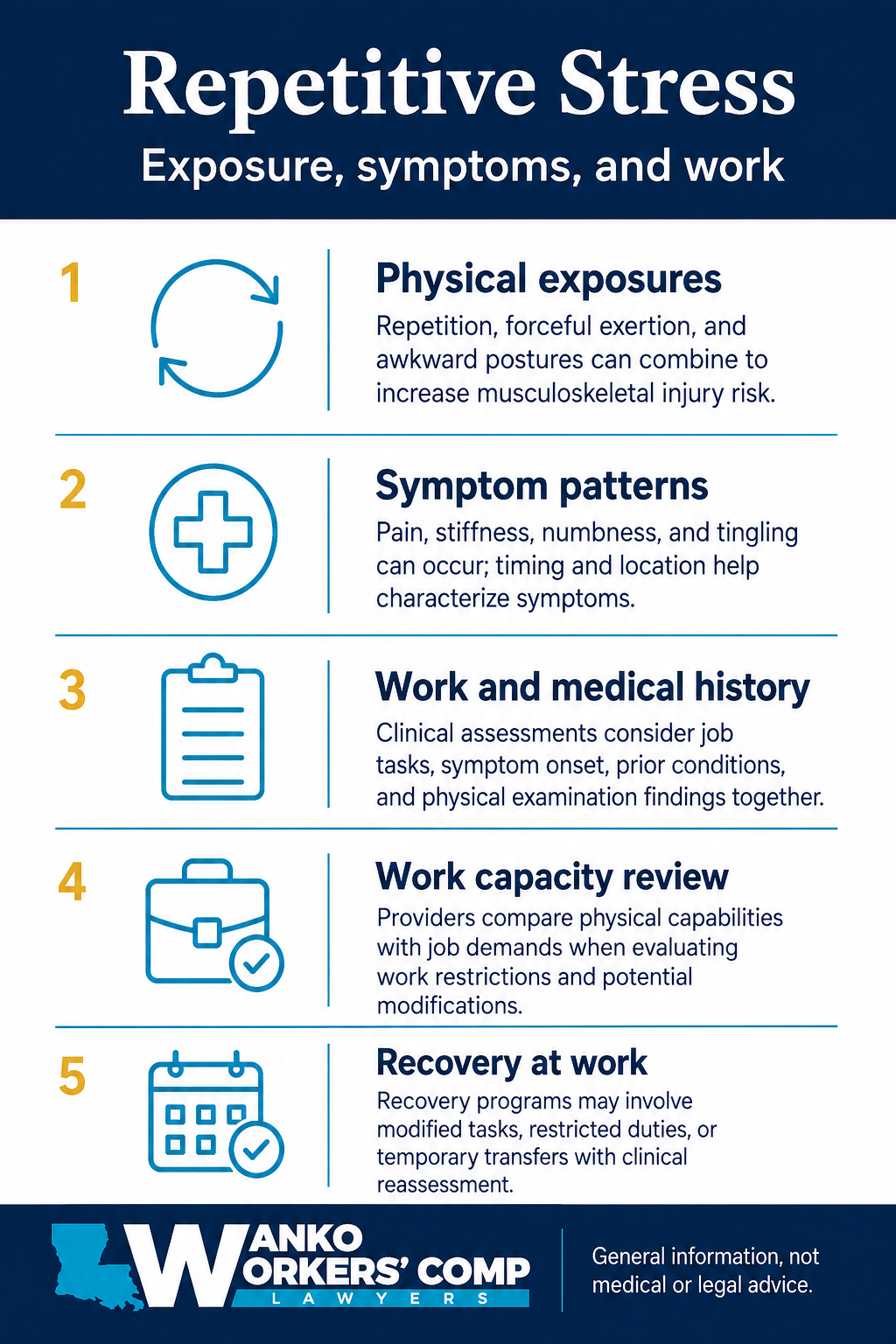
Sources: NIOSH: risks | NIOSH: symptoms | NIOSH: assessment | NIOSH: recoveryPhysical exposures: Repetition, forceful exertion, and awkward postures can combine to increase musculoskeletal injury risk. Symptom patterns: Pain, stiffness, numbness, and tingling can occur; timing and location help characterize symptoms. Work and medical history: Clinical assessments consider job tasks, symptom onset, prior conditions, and physical examination findings together. Work capacity review: Providers compare physical capabilities with job demands when evaluating work restrictions and potential modifications. Recovery at work: Recovery programs may involve modified tasks, restricted duties, or temporary transfers with clinical reassessment.
Repetitive lifting, gripping, or twisting
Assembly line or production work
Typing, data entry, or prolonged computer use
Repeated use of tools or machinery
Sustained awkward or static postures
Because these injuries develop gradually, workers may not realize their symptoms are work-related until the condition becomes severe. Our Covington workers’ compensation attorneys help injured Louisiana workers connect repetitive job duties to cumulative trauma injuries and protect their right to workers’ compensation benefits.
Common Types of Work-Related Repetitive Stress Injuries
Repetitive stress injuries can affect many different parts of the body, depending on the nature of a worker’s job duties. For injured workers in Covington, these injuries often develop slowly and worsen over time, making early diagnosis and treatment especially important. Because symptoms may fluctuate, workers’ compensation insurers frequently question whether these conditions are truly work-related. Common types of repetitive stress injuries suffered in the workplace include:
Carpal tunnel syndrome, caused by compression of the median nerve in the wrist
Tendinitis and tenosynovitis, involving inflammation of tendons from repeated use
Bursitis, which results from irritation of fluid-filled sacs that cushion joints
Rotator cuff injuries, often caused by repetitive overhead motion
Cubital tunnel syndrome, involving compression of the ulnar nerve at the elbow
Chronic back or neck strain, caused by prolonged repetitive motion or poor ergonomics
These conditions can lead to pain, weakness, numbness, and loss of function that interfere with job performance. Even when symptoms begin mildly, repetitive stress injuries can become debilitating without proper treatment. Our Covington workers’ compensation attorneys help injured Louisiana workers ensure that repetitive stress injuries are accurately diagnosed and fully considered within a workers’ compensation claim.
Symptoms and Long-Term Effects of Repetitive Stress Injuries
Symptoms of repetitive stress injuries often develop gradually, which can make them easy to dismiss at first. For workers in Covington, early signs may include soreness, stiffness, or fatigue that improves with rest but returns during work activities. Over time, these symptoms can become more frequent and severe, eventually affecting daily life and the ability to work. Repetitive stress injuries can impact muscles, tendons, joints, and nerves, leading to a wide range of symptoms that vary depending on the affected area. Common symptoms and long-term effects include:
Persistent pain or aching in the affected area
Weakness or reduced grip strength
Numbness or tingling in the hands, arms, or legs
Swelling or inflammation
Reduced range of motion or stiffness
Chronic pain that interferes with work and daily activities
Left untreated, repetitive stress injuries may lead to permanent limitations or require surgical intervention. Long-term effects can make it difficult for injured workers to return to their prior positions. Proper documentation of symptoms and progression is critical to protecting workers’ compensation benefits for cumulative trauma injuries.
Workers’ Compensation Benefits for Repetitive Stress Injuries
Workers’ compensation benefits for repetitive stress injuries are intended to address both medical treatment and lost income when cumulative trauma affects a worker’s ability to perform job duties. For injured workers in Covington, these benefits can be critical, particularly when symptoms worsen gradually and interfere with work over time. Louisiana workers’ compensation law provides coverage for injuries caused by repetitive job tasks, even without a single accident. Medical benefits for repetitive stress injuries may involve treatment from primary care providers, orthopedic specialists, neurologists, or occupational medicine physicians. Because these injuries often affect muscles, tendons, and nerves, recovery may require extended treatment rather than a short course of care. Workers’ compensation benefits for repetitive stress injuries may include:
Doctor visits and ongoing medical care
Diagnostic testing, including nerve studies and imaging
Physical or occupational therapy
Prescription medications and pain management
Ergonomic evaluations and job modifications
If a repetitive stress injury limits an employee’s ability to work, wage replacement benefits may apply. In more severe cases, long-term or permanent disability benefits may be available when ongoing limitations affect earning capacity.
Proving Cumulative Trauma and Work-Related Causation
One of the most challenging aspects of a repetitive stress injury claim is proving that the condition was caused by work activities. For injured workers in Covington, insurers often argue that symptoms are unrelated to job duties or resulted from activities outside of work. Successfully pursuing workers’ compensation benefits requires clear documentation connecting repetitive tasks to the injury. Proving cumulative trauma typically involves demonstrating how specific job duties place repeated stress on the affected area over time. Medical opinions, job descriptions, and work history all play important roles in establishing causation. Common challenges raised by insurers include:
Claims that no specific accident occurred
Allegations of pre-existing or age-related conditions
Arguments that symptoms developed too gradually to be work-related
Disputes over the extent of disability
Proper reporting of symptoms and consistent medical documentation are critical to overcoming these challenges. Without clear evidence linking job duties to the injury, workers’ compensation benefits may be delayed or denied.
Return-to-Work Issues and Ongoing Limitations After Repetitive Stress Injuries
Return-to-work decisions are especially complex in repetitive stress injury cases. For workers in Covington, returning to the same repetitive tasks that caused the injury can worsen symptoms or lead to reinjury. Employers and insurers may push for a return to work based on the absence of a visible injury, even when pain and functional limitations persist. Modified duty may be appropriate in some cases, but it must realistically account for medical restrictions. Repetitive motions, prolonged use of affected body parts, or sustained awkward postures can all interfere with recovery. Repetitive stress injuries may lead to ongoing limitations such as:
Restrictions on repetitive or forceful movements
Reduced productivity due to pain or fatigue
Need for long-term work modifications
Difficulty returning to prior job duties
Careful handling of return-to-work issues is essential to protecting workers’ compensation benefits and preventing further injury. Decisions made too early can have lasting consequences for both recovery and financial stability.
Third-Party Claims and Repetitive Stress Injuries
In some cases, repetitive stress injuries involve more than a workers’ compensation claim. For injured workers in Covington, additional claims may exist when a third party’s negligence contributed to the injury. While workers’ compensation generally prevents lawsuits against an employer, it does not bar claims against negligent third parties whose actions played a role in causing cumulative trauma.
Third-party claims related to repetitive stress injuries may arise from:
Defective or poorly designed tools or equipment
Machinery that lacks proper safety features
Ergonomic failures caused by third-party vendors or contractors
Workstations designed or maintained by non-employers
Unlike workers’ compensation claims, third-party claims require proof of fault. When successful, these claims may allow injured workers to pursue compensation beyond workers’ compensation benefits. Because these claims must be coordinated carefully, identifying third-party liability early is important to protecting overall recovery and avoiding complications.
How Wanko Workers’ Comp Lawyers Help With Repetitive Stress Injury Claims
Repetitive stress injury claims require careful development and documentation. Workers’ compensation insurers often challenge these claims by arguing that symptoms are unrelated to work or caused by everyday activities. Wanko Workers’ Comp Lawyers help injured workers protect their rights by focusing on how cumulative job duties contributed to injury over time.
Our firm helps injured workers by:
Developing claims based on detailed job duty analysis
Coordinating medical documentation to establish causation
Addressing disputes over diagnosis, treatment, and work restrictions
Protecting wage replacement and disability benefits
Challenging premature return-to-work demands
With more than 20 years of experience handling workers’ compensation claims, our team primarily serves injured workers in Covington, with offices in Thibodaux and New Orleans. We help injured Louisiana workers pursue the full benefits available under workers’ compensation law and do not charge fees or costs unless we secure more compensation than what was offered.
Contact Wanko Workers’ Comp Lawyers for Your Covington Repetitive Stress Injury Claim
A repetitive stress injury can gradually disrupt your ability to work and earn a living. For injured workers in Covington, these claims are often misunderstood and unfairly challenged, even when symptoms are severe and long-lasting. Early guidance can make a meaningful difference in protecting workers’ compensation benefits and securing appropriate medical care.
Wanko Workers’ Comp Lawyers help injured Louisiana workers understand their rights after repetitive stress injuries and navigate disputes with workers’ compensation insurers. Whether your injury developed slowly over time or worsened after months of repetitive work, our team is prepared to help.
To learn more about your options after a repetitive stress injury, call (985) 202-9907 today or connect with us online to schedule a consultation. With offices in Covington, Thibodaux, and New Orleans, we help injured workers throughout Louisiana pursue the workers’ compensation benefits they are entitled to under the law.
Yes, you may be able to receive workers' compensation if you were injured at work because repeated job duties caused a repetitive stress injury. These claims can involve conditions such as carpal tunnel syndrome, tendinitis, bursitis, rotator cuff injuries, cubital tunnel syndrome, or chronic neck and back strain. In Covington, New Orleans, and throughout Louisiana, workers may qualify for medical treatment, wage benefits, disability benefits, and job-related restrictions if the injury affects their ability to work. The challenge is often proving that the condition came from work instead of age, hobbies, prior injuries, or unrelated health issues. Strong medical records, detailed job duty descriptions, and consistent symptom reporting can help support the claim.
Insurance companies often dispute a repetitive stress injury claim because the symptoms usually develop gradually instead of after one obvious accident. If you were injured at work over weeks, months, or years, the insurer may argue that there is no clear work-related event. The insurer may also claim that your condition is degenerative, pre-existing, age-related, or caused by activities outside your Louisiana job. These arguments can delay medical care, wage checks, diagnostic testing, therapy, and approval for work restrictions. A workers' compensation attorney can help gather medical evidence and job history details to connect your repetitive work duties to your injury.
If you suffered a repetitive stress injury while working in Covington, New Orleans, or elsewhere in Louisiana, workers' compensation benefits may cover necessary medical care. Treatment may include doctor visits, diagnostic testing, medications, physical therapy, occupational therapy, injections, specialist care, or surgery depending on the injury. If your doctor says you cannot work or can only perform limited duties, you may also qualify for wage replacement benefits. Severe repetitive stress injuries can lead to long-term restrictions, permanent disability ratings, or vocational rehabilitation if you cannot return to the same type of work. An attorney can help protect your benefits if the insurer questions your diagnosis, treatment plan, or ability to return to work.
Yes, repetitive stress injuries may qualify when repeated job duties cause or contribute to a disabling condition over time. Louisiana recognizes occupational disease claims when the illness or disease is due to causes and conditions characteristic of and peculiar to the worker’s trade, occupation, process, or employment. The page notes that these claims are often disputed because symptoms develop gradually, there may be no single accident date, and insurers may blame age or non-work activities. Common examples include carpal tunnel syndrome, tendinitis, bursitis, rotator cuff injuries, cubital tunnel syndrome, and chronic back or neck strain. Strong medical documentation, job-duty descriptions, and treatment history are especially important in 2026 because the claim usually turns on proving cumulative trauma rather than one sudden event.reach out to us
Repetitive stress injuries develop gradually through repeated movements or ongoing physical strain rather than a single accident. Symptoms often begin as mild discomfort and worsen over time. Workers may not immediately realize their condition is work-related. These injuries commonly affect muscles, tendons, joints, and nerves. Early diagnosis and treatment can help prevent long-term complications.
Repetitive stress injuries can occur in many industries, including manufacturing, healthcare, construction, and office environments. Jobs involving repetitive hand movements, lifting, typing, or tool use carry increased risk. Workers who maintain awkward positions for extended periods may also develop these conditions. Risk levels depend on frequency, force, and duration of repetitive tasks. Proper ergonomic practices can help reduce injury rates.
Yes, ergonomic improvements can significantly reduce the risk of repetitive stress injuries in the workplace. Proper workstation design, equipment adjustments, and task rotation may reduce strain on muscles and joints. Employers often use ergonomic assessments to identify potential hazards. Training workers on safe body mechanics can also improve injury prevention efforts. Consistent ergonomic practices benefit both employees and employers over time.
If you suffered a repetitive stress injury after being injured at work in Covington, New Orleans, or anywhere in Louisiana, we can help you understand your workers' compensation rights. We can review your job duties, medical records, work restrictions, wage history, and insurance communications to identify claim issues early. Our team can help respond when the insurer argues that your symptoms are unrelated to work or caused by a pre-existing condition. Because repetitive stress injury claims often require detailed proof of cumulative trauma, having an attorney can make the process easier to manage. To discuss your claim and next steps, reach out to us.
Additional Information in Louisiana
Mayo Clinic - Tendinitis Symptoms and Causes: Explains tendinitis, including symptoms, causes, and risk factors related to repeated movement. This site is helpful for the repetitive stress injury focus page because tendinitis can develop when job duties require the same motion again and again. A Louisiana worker who performs repeated lifting, reaching, gripping, bending, or tool use may use this page to understand how tendon pain can become work-related. The resource also explains why pain, tenderness, and swelling should be taken seriously when symptoms interfere with work. In a workers' compensation case, this information can help show why gradual tendon damage may still be connected to being injured at work. This resource helps the focus page by explaining one of the specific medical conditions that can support a repetitive stress injury claim.
OSHA - Ergonomics Identify Problems: Explains how employers and workers can identify ergonomic problems that may lead to repetitive stress injuries. This site is helpful for the repetitive stress injury focus page because it discusses reviewing workers' compensation records, injury logs, first aid reports, and worker complaints to find patterns of ergonomic harm. A Louisiana worker in Covington or New Orleans can use this resource to understand how repeated tasks, awkward posture, force, and workplace conditions may contribute to an injury over time. The page also supports the idea that repetitive stress injury claims often require evidence beyond one single accident. It can help injured workers understand why documenting symptoms, job duties, and workplace conditions is important in a workers' compensation case. This resource directly helps the focus page by showing how repetitive stress injuries may be identified and connected to the work environment.
NIAMS - Carpal Tunnel Syndrome: Explains the symptoms, causes, and basic medical background of carpal tunnel syndrome. This site is helpful for the repetitive stress injury focus page because carpal tunnel syndrome is one of the most common conditions linked to repetitive hand and wrist use. A worker who was injured at work in Covington, New Orleans, or elsewhere in Louisiana can use this resource to understand symptoms such as numbness, tingling, pain, and weakness. The page can also help readers understand why medical evaluation is important when repetitive work causes nerve-related symptoms. In a workers' compensation case, this information can help explain why a repetitive stress injury may affect job duties such as typing, gripping, lifting, scanning, or tool use. This resource supports the focus page by giving readers a trusted medical explanation for a common repetitive stress injury diagnosis.
Talk With a Louisiana Repetitive Stress Injury Lawyer
Get help documenting repetitive stress symptoms and responding when a workers' compensation carrier disputes them.
✓Report the workplace event and when the symptoms began to your employer as soon as possible.
✓Gather treatment notes, ergonomic recommendations, and any benefits paperwork related to the symptoms.
✓Preserve job-duty details, symptom timelines, and every carrier response.
✓Speak with a Louisiana repetitive stress injury lawyer before the claim is dismissed as unrelated.
CONTACT US nOW
Whether you have suffered an immediate injury or have endured a long-term disability or chronic illness, you deserve to have the support you need to recover. Our work injury attorneys will provide you with nothing less than compassionate understanding and exceptional legal counsel.
We are here to help. Contact us online anytime.
Covington LocatioN
19295 N. 3rd St., #1, Covington, LA 70433
New Orleans Location
1140 St. Charles St., New Orleans, LA 70130
Thibodaux Location
407 W. 3rd St., Thibodaux, LA 70301
A trusted law firm stands not just on its legal victories, but on the strength of its integrity, compassion, and unwavering commitment to those it serves.