
When it comes to accepting a workers' comp lump-sum settlement, it’s important to understand you are never the insurance company’s priority – an offer is being made to limit the expense and liability of your claim by locking in a lower cost for the insurance company through a settlement payout.
At Wanko Law, we believe anyone dealing with a work injury deserves immediate access to an experienced Louisiana workers’ compensation law firm. We focus exclusively on fighting for the rights of injured workers and their families and offer free and confidential consultations to discuss your case.
As discussed elsewhere on this site, the best time to consult with an experienced work injury lawyer in New Orleans, Covington or Raceland, is as soon as possible after an injury occurs. You have the right to choose your own physician, which will have a major impact on the treatments and benefits to which you are entitled. Choosing a doctor and making other major decisions about your care are always best done with the help and guidance of an experienced workers’ compensation law firm.
Workers’ compensation insurers often use impairment ratings, Functional Capacity Evaluations and determinations of Maximum Medical Improvement to determine settlement offers, despite the fact that a disability or impairment ratings is typically not required by Louisiana workers’ compensation law. Each of these exams and determinations can have a significant impact on your rights to continue receiving benefits, as well as what benefits you may be entitled to for years to come. Unfortunately, by the time an injured worker becomes unsatisfied with the results, significant damage to his or her case may have already been done by proceeding without qualified legal help throughout this complex process.
Impairment ratings are usually determined during a Functional Capacity Evaluation (FCE). This rating is often used by the insurance company to determine monetary awards (i.e. settlement offers). However, under Louisiana law, an impairment rating is not used to determine Supplemental Earnings Benefits, Temporary Total Disability benefits or Permanent Total Disability benefits. Rather, this impairment rating percentage is used to determine a monetary award under LA R.S. 23:1221 for Permanent Partial Disability (PPD) benefits, which concerns cases of amputation or loss of use of parts of an injured employee’s body.
For these reasons, it is somewhat rare that an impairment rating will be required for a Louisiana workers’ compensation claim. However, the fact that workers’ compensation insurance companies frequently insist injured workers undergo examinations to determine such ratings, and then use these ratings in settlement negotiations, leaves injured workers exposed and confused. This is another example of why consulting with an experienced Louisiana workers’ compensation law firm at the outset of your case is often vital to protecting your rights and the financial well-being of you and your family.
At Wanko Law, our offices believe injured workers and their families are too often operating at a significant disadvantage throughout this process. In fact, we will review any potential settlement offer you receive and if we cannot get you more, we will not take any fees or expenses.
There are good reasons why an employee may choose to settle a claim, including the fact that a claim generally reaches maximum value between the time an employee completes major treatment and the time he or she can return to work. The passage of time, vocational rehabilitation, and an increasing ability to return to work in some capacity may all erode the value of a claim.
However, many challenges remain:
Under Louisiana workers’ compensation law, there are generally two types of work-injury settlement:
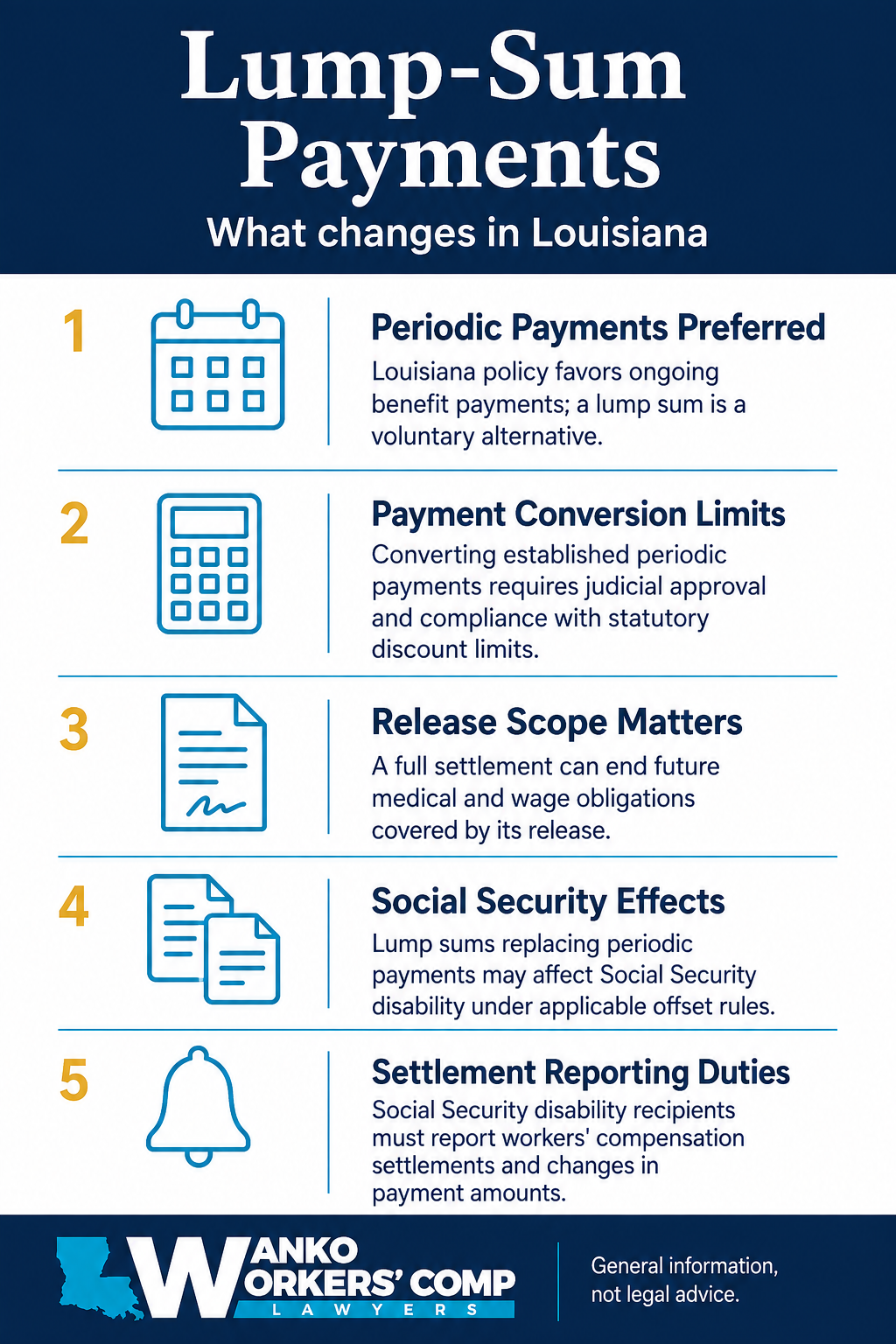
Lump sums must be very carefully negotiated by an experienced work injury attorney in New Orleans, Covington, or Raceland. Naturally, the workers’ compensation insurer will push for steep discounts in exchange for a fast settlement. However, it’s important to note that without any present-value discount, the insurer benefits in a number of important ways:
At Wanko Law, we focus exclusively on fighting for the rights of injured workers and their families. We don’t believe in negotiating away the full value of your claim for a quick payout. While we are here to serve our clients and their families, and their desires are critical to every decision we make, we know it is always a good deal for the insurance company to settle your claim for its full and fair value today.
If you have been injured, call day or night for a free and confidential consultation to discuss your rights. Call 985-202-9907.
Reviewed for legal accuracy by Steve Wanko on .

Social Security Administration - Workers’ Compensation Lump-sum Settlements: Examines the Social Security Administration's (SSA) processing of these settlements to ensure they correctly offset Disability Insurance benefits. The report found widespread errors in processing, affecting thousands of cases and costing millions in improper payments. The review highlights the need for improved SSA staff training, better use of management information systems, and possibly establishing specialized workgroups to enhance accuracy. This document is useful for understanding potential errors and inefficiencies in lump sum settlement processing, which can help legal professionals and claimants anticipate and address similar issues in their cases.
Insurance Business America - Workers comp settlement chart: Everything you need to know: detailed guide on workers' compensation settlement charts, explaining their use in estimating compensation amounts for job-related injuries. It covers different states' approaches, showcasing how compensation is calculated based on factors like the severity of injuries and the affected body parts. This guide is beneficial for understanding potential compensation amounts and negotiating lump sum payments, offering a comparative tool for different jurisdictions.
Louisiana Workforce Commission - Injured Workers Disputed Claims FAQs: Provides guidance for injured workers, particularly those with disputed claims. It explains the benefits entitled to injured workers, the process for handling denied claims, and the specifics of lump sum settlements. Additionally, it outlines steps to take if you're not receiving compensation checks and addresses concerns about employer retaliation. This resource can aid in understanding the process and options available when negotiating a lump sum payment claim, ensuring that claimants are well-informed and prepared to engage in discussions or disputes related to their workers' compensation claims.